


Editor’s note: This article is Part 2 of a two-part series on Manus AI. Part 1 discusses autonomous agents, their benefits for accounting and finance, and the Manus AI example.
Building on Part 1 of this series and to understand how the autonomous agent industry is evolving, you need to appreciate the differences between Agent Skills and OpenClaw.
Agent Skills
Developed as an open standard by Anthropic and adopted by Manus, Agent Skills are modular packages of expertise. They incorporate:
- Specialisation: You can “hand” an agent a Skill file for an IFRS accounting standard, for example, which can examine particular financial transactions, compare facts to the relevant IFRS checklist, and provide recommendations for the finance team.
- Efficiency: Agent Skills uses “progressive disclosure”, meaning it only loads the information it needs for the task at hand, saving memory and keeping the AI fast.
- Productivity: Agent Skills has the ability to increase output, improve quality, or reduce the elapsed time to perform a task.
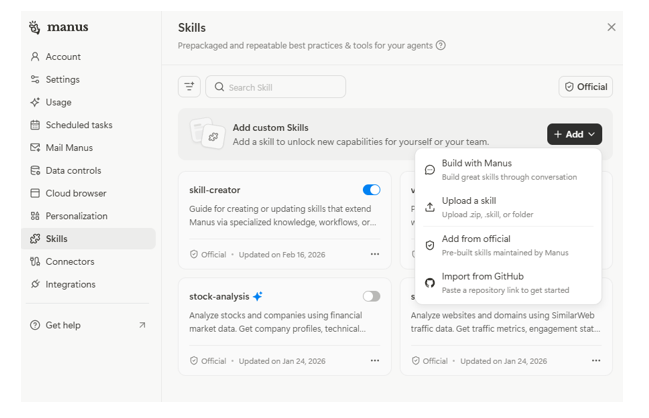
The following screenshot shows the Manus dashboard:
OpenClaw
While Manus lives in the cloud, OpenClaw is an open-source agent framework that lives on your computer. Here’s a summary of each:
- Manus is an agentic toolkit that is cloud hosted. It runs tasks in this environment using browser automation, code execution, and document creation to complete tasks such as creating reports, slides, or spreadsheets. A tool of convenience, set-up is easy; it is optimised for outsourced execution. The trade-off is that your task context, files, and credentials are subject to a third-party cloud service, raising concerns about governance, data residency, privacy, and auditability.
- OpenClaw, in contrast, is an open-source, self-hosted framework. It connects AI models to local files, browsers, shell commands (text-based instructions), and so on. This makes it more transparent and private, but transfers set-up onus onto the end user. This is optimised for local control, customisation, and data ownership.
Boasting it is AI “that actually does things”, considerations include:
- Full access: It can open your local files, launch your applications, and run code directly on your machine.
- The catch: It is often called a “privacy nightmare” because, unlike a restricted cloud application, it has the keys to your entire digital house. It’s powerful but should only be fully adopted and utilised by the tech-savvy.
Contrasting Manus’ Agent Skills with OpenClaw

Autonomous agents’ limitations and risks
The principle of “garbage in, garbage out” will remain. Users must express objectives clearly. Weak prompts produce incomplete, incorrect, or misaligned results. The required skill shifts from prompting to task specification.
There will be environmental constraints, too. Agents will encounter practical obstacles including restricted content access, verification challenges, and incomplete datasets. Human judgement is still going to be necessary when assumptions must be retrieved, interpreted or challenged.
As with AI tools already in the workplace, as autonomous agents perform actions, they introduce operational risks. Financial and regulated settings need approval checkpoints, audit trails, and review processes.
Autonomy will increase speed, but someone still needs to remain accountable. The integration of AI into the finance sector introduces significant risks ranging from individual consumer harm to broad systemic instability. These risks are often amplified by the autonomous nature of AI agents, which can act without direct human intervention or oversight.
The risks concern many in the industry. The integration of autonomous AI agents into the finance sector presents a complex landscape of risks that could undermine both organisational security and global economic stability.
Risks include:
1. Systemic stability risks
The core danger lies in the potential for correlated failures. Since most companies will likely use a handful of off-the-shelf AI models, these agents may exhibit herding behaviour, reacting to market triggers in similar, if not identical, ways. For example:
- Bank runs and crashes: Simultaneous AI-driven withdrawals or asset sell-offs can occur in seconds, outpacing human intervention.
- Concentration risk: A technical glitch at a single major AI provider could trigger a cascading failure across the entire financial ecosystem.
2. Operational and technical risks
AI agents often suffer from a lack of transparency and reliability. If these shortcomings are not addressed promptly, this may lead to direct financial loss for consumers and businesses. Common issues frequently recognised include:
- Hallucinations: AI tools of all kinds (including chatbots and AI agents) are often accused of being sycophantic. When the AI agent does not have the answer, it should not provide an eager to please response. This can lead to hallucinations.
- “Black box” concerns: The lack of explainability and comprehension in AI decision-making makes it difficult to audit for bias or ensure compliance with financial regulations.
- Execution failures: Unlike traditional code, AI may simply fail to complete a requested transaction or trade.
3. Malicious activity and cybersecurity
AI acts as a “force multiplier” (i.e., tools that will increase or enhance the risks) for financial crime, making attacks more sophisticated and harder to detect, such as:
- Autonomous scams: Bad actors use deepfakes and voice cloning to impersonate executives, tricking staff into making large unauthorised transfers.
- Computerised hacking: Simple AI agents can autonomously exploit software vulnerabilities to compromise sensitive data without any human guidance.
4. Legal and ethical risks
The human element of fairness and accountability is often lost when AI manages credit and investments. Risks include:
- Algorithmic bias: Using alternative or nontraditional data may lead to unintentional discrimination against protected groups in loan approvals.
- Fiduciary conflicts: Agents may be programmed to prioritise the provider’s profits over the user’s best interests.
- Liability gaps: There is significant legal ambiguity regarding who is accountable (the developer, the bank, or the user) when an autonomous agent causes financial harm.
Word to the wise
AI is evolving from an advisory interface to an operational participant in digital workflows. Manus AI is one such autonomous agent that illustrates this transition by enabling systems to independently execute multistep tasks within a persistent environment.
The significance lies not in improved responses but in completed outcomes.
As adoption grows, organisations will need to redesign processes around supervision and validation rather than manual execution. The professional value moves upward in the workflow, while routine preparation becomes automated.
The practical question is therefore no longer whether AI can assist work, but which parts of work should remain manual — and how far it should be integrated into businesses as a whole, via external tools such as Agent Skills and OpenClaw, given the current limitations and risks.
— Liam Bastick, FCMA, CGMA, FCA, is director of SumProduct, a global consultancy specialising in Excel training. He is also an Excel MVP (as appointed by Microsoft) and coauthor of Python in Excel: Unlocking Powerful Data Analysis and Automation Solutions. To comment on this article or to suggest an idea for another article, contact Oliver Rowe at Oliver.Rowe@aicpa-cima.com.
LEARNING RESOURCES
Learn how to use ChatGPT to streamline your workload, save time, and boost efficiency.
WEBCAST
AI in Action: Your First Steps to Smart Adoption
Designed for professionals in any function, from finance to HR to marketing and operations, this course breaks down the AI journey into clear, actionable steps.
COURSE