


Editor’s note: This article is Part 1 of a two-part series on Manus AI and autonomous agents. Part 2 explains the difference between Agent Skills and the OpenClaw framework and highlights the risk categories associated with autonomous agents.
Recent developments in artificial intelligence (AI) have shifted focus from conversational systems to action-oriented agents capable of completing real-world tasks. Manus AI is a good example. It is a platform designed to autonomously execute multistep workflows within a persistent computing environment.
Priced similarly to other AI tools, it is one of the most talked about examples of AI.
The ongoing discussions around Manus have been driven by its perceived potential to streamline workflows, enhance creativity, and automate complex tasks (although more on that later). Its accessibility and versatility have sparked discussions about its possible effects on various industries, from education to business — accounting and finance included.
From responses to outcomes
Most organisations first encountered AI through what are known as conversational tools, such as Open AI’s ChatGPT, Anthropic’s Claude, Google’s Gemini, et al. These systems showed impressive language capability but remained fundamentally advisory.
Many of us treat different AI systems as broadly similar, but that’s wrong. In practice, they operate at three distinct levels of agency:
Conversational AI: The examples include early ChatGPT and Claude models. Conversational AI produces text, explanations, or code based upon prompts, which is what generative AI is often seen to be. The interaction is transactional and session-based. Once the conversation ends, the system retains no operational state. Typical outputs are explanations, drafted documents, or suggested methodologies. These systems support decision-making but do not implement decisions.
Agentic AI: A workflow-integrated assistant is a good example. Agentic AI introduces goal orientation. The system may trigger actions through predefined integrations such as sending emails or updating records. However, behaviour remains constrained by pre-configured workflows. Human supervision and structured instructions are still necessary. The system performs tasks but only inside defined boundaries.
Autonomous agents: These operate at a higher level of independence. Instead of executing instructions, they interpret objectives and determine the sequence of actions required. Key characteristics include:
- Persistent working environment.
- Independent planning.
- Adaptive execution.
- Multistep task completion.
In essence, the user specifies the outcome rather than the procedure.
Arguably, this last level of agency provides answers rather than results.
The next phase of AI adoption centres not on generating information but on completing tasks. Workers in most industries have been worried that AI is coming for their job. Here, this next phase wants to take on the competent junior staff member: Give them a task with minimal guidance, and (hopefully) they will complete it competently. This is a defining characteristic of these emergent autonomous agents. These systems can independently plan and execute tasks to achieve a goal. Manus AI is an early example of such an autonomous agent
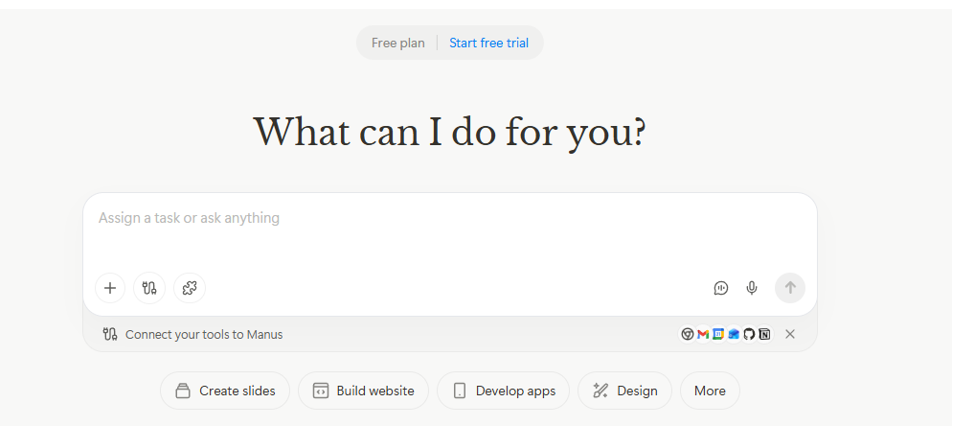
It is designed to translate human intent into completed deliverables. The system operates within a cloud-based workspace that remains active beyond a single user session. Typical capabilities include:
- Browsing information sources.
- Writing and executing code.
- Analysing datasets.
- Producing formatted reports.
- Generating spreadsheets or presentations.
Autonomous agents must manage complexity that exceeds the capability of a single reasoning process. Manus addresses this by dividing work across specialised components that function as a co-ordinated system.

This structure resembles a project workflow rather than a single computation. The agent iteratively plans, acts, and checks until the task is completed. As the start of an example, you might provide a task such as:
“Build a housing project finance model referencing Housing Australia guidelines, including funding sources, cash-flow waterfalls, DSCR and financial statements …”
Manus might respond initially as follows:
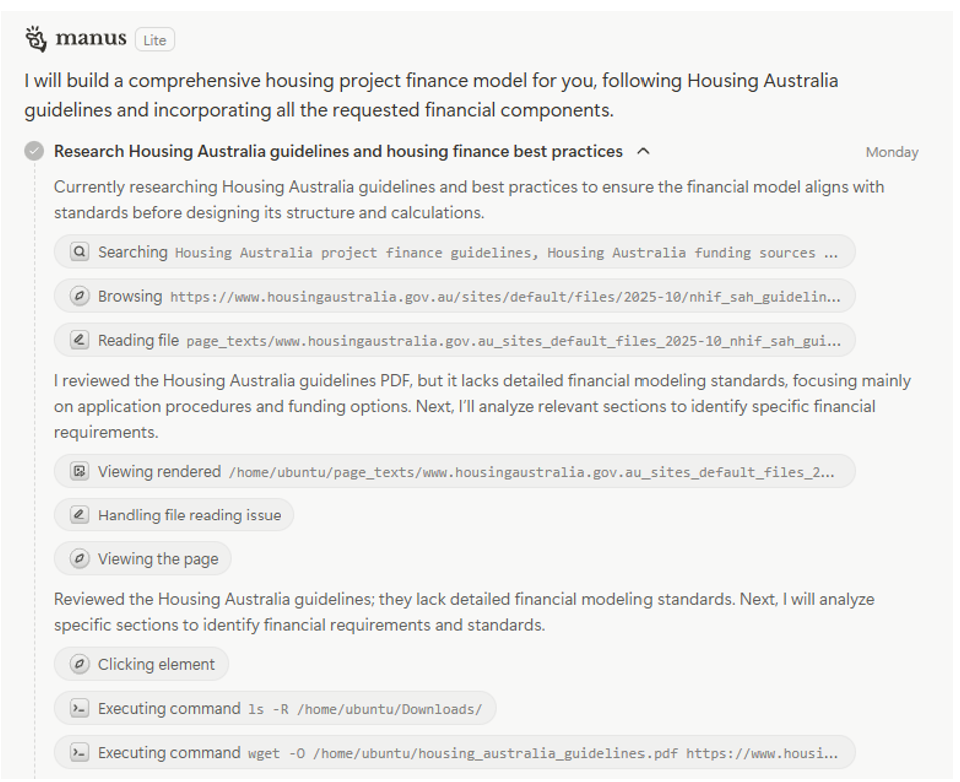
Do you see how Manus AI has undertaken the task and reported back what it has found? We may know nothing about Housing Australia (that’s actually the point here), but it has embarked on its task, researched, and reported back on what it has found. While traditional chatbots act as advisers that respond to queries, autonomous agents function as colleagues that independently execute multistep tasks. This is a large step forward. The primary differences between these two paradigms include:
- Planning vs responding: Chatbots operate as interactive assistants that provide text, code, or explanations based upon specific user prompts. They require continuous human guidance to break down and move through complex problems. In contrast, Manus AI uses a “Planner Agent” to break objectives into manageable sub-tasks, without needing the user to define the procedure.
- Execution and tool use: Chatbots focus on dialogue and factual accuracy but typically do not execute physical or digital tasks for the user. Autonomous agents actively invoke tools and interact with external systems such as web browsers, databases, and code execution environments to perform work. Manus AI can scrape competitor websites, extract data, and generate compliance reports entirely without human intervention.
- State and memory: For chatbots, the interaction is generally transactional and session-based (i.e., they are temporary, isolated discussion threads only retained while the chat window is open). Once a conversation ends, the system usually retains no operational state for future tasks.
Autonomous agents operate in persistent computing environments (like a cloud-based sandbox) that remain active beyond a single session. This allows them to store files, track intermediate results, and continue processing complex tasks asynchronously in the background. - Core responsibility: The fundamental distinction can be summarised as “a chatbot assists work, while an autonomous agent performs work”. It is the transition from conversation to action.
In summary:
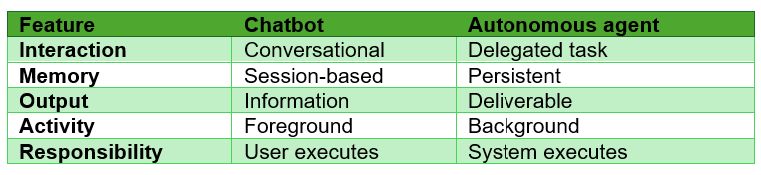
For example, while a chatbot might tell you how to conduct market research, autonomous agents such as Manus AI can activate hundreds of sub-agents to analyse researcher profiles, synthesise the data, and deliver a boardroom-ready slide deck in minutes.
Think about how you may have implemented AI so far. With an autonomous agent, you can extend tasks, create multistep workflows, and iterate. Benefits could include:
- Autonomous agents can complete processes involving research, calculation, formatting, and documentation without continuous user input.
- Tasks involving large volumes of structured information, such as document review or data reconciliation, will benefit significantly from simultaneous/parallel execution.
- Modern agents integrate with digital platforms and storage systems, reducing manual transfer of information between applications.
In my own world, this particularly reduces copy-paste errors in spreadsheet and modelling environments.
Manus AI is not just a new application; it is also about Agent Skills. Think of these as “specialist plugins” that allow an AI to go from a general assistant to a professional legal reviewer or financial analyst in seconds.
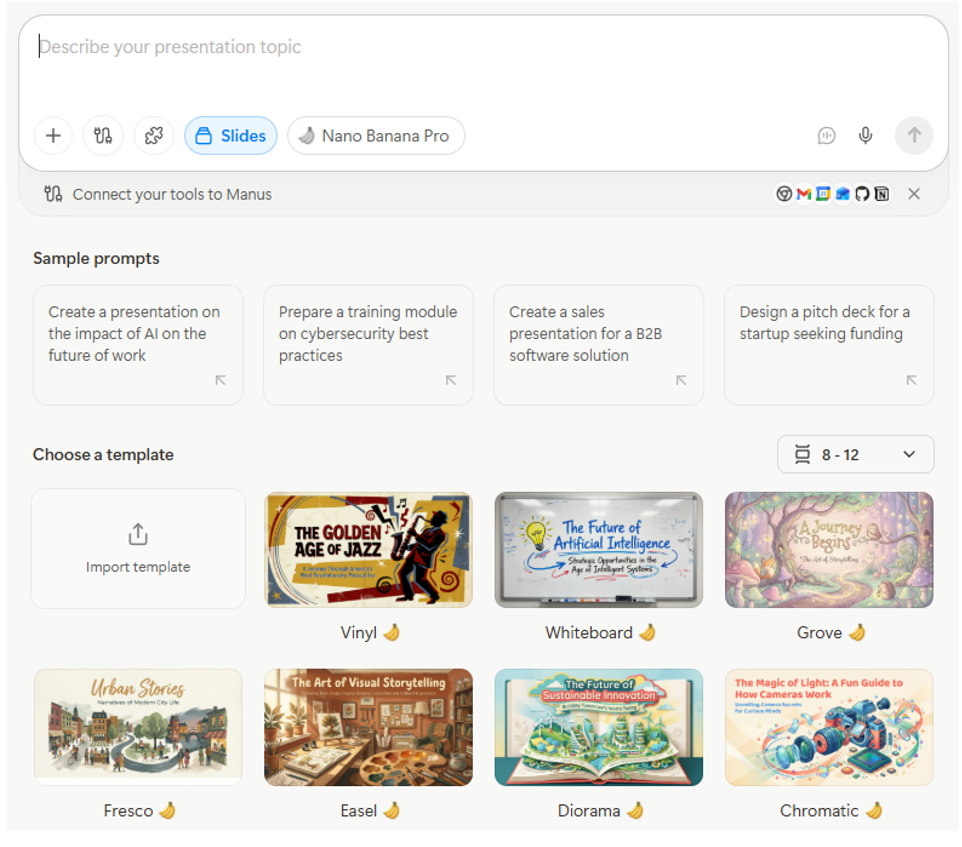
For example, you might have heard of Nano Banana. This is the quirky brand name for Google Gemini’s native image-generation engine. Nano Banana Pro is the “artist” used for creating high-end professional assets.
When you ask Manus AI to build a presentation, it doesn’t just fetch stock photos. It uses Nano Banana Pro to generate custom infographics, logos, and slide designs on the fly. It’s the difference between a basic PowerPoint set of slides and a professionally designed pitch deck.
For accounting and finance, the potential benefits are many. Autonomous agents are particularly well suited to professions characterised by structured information and repeatable workflows, such as the work management accountants perform. Among other tasks, they may assist with:
- Reporting preparation: Agents can assemble data and draft reports, allowing professionals to focus on interpretation rather than compilation.
- Compliance automation: Routine validation tasks such as arithmetic verification and consistency checks may be automated while retaining human review.
- Scenario and sensitivity analyses: Systems can run multiple simulations and present ranges of outcomes instead of single deterministic projections.
- Error reduction: Direct system interaction reduces manual data transfer, historically a major source of spreadsheet errors.
While Manus AI has been praised for its intuitive design and helpful outputs, some claims about its capabilities may be exaggerated. Independent evaluations suggest it performs well for routine tasks and content generation, but its limitations become apparent in highly specialised or nuanced scenarios. As with all AI, it is important to distinguish for yourself between genuine utility and marketing-driven hype.
Certainly, Manus is widely used for content creation, task automation, and data analysis. Its main strengths lie in accessibility and ease of use for nontechnical users, and integration capabilities with existing platforms. Regular updates and support also contribute to its sustained popularity. Unlike many current alternatives, Manus seemingly focuses on delivering practical solutions without overwhelming users with technical complexity.
However, while feedback from users highlights its reliability for everyday applications, some note that more advanced tasks may not work as well as hoped. This is an important point. It should be stressed that autonomous agents will not replace expertise. They alter the distribution of effort.
Yet again, used correctly and appropriately, they should augment our work, not replace us. Just like with the Power BI suite of tools, mechanical preparation will continue to decrease. Analytical interpretation will increase. Our roles will shift from constructing information to checking it and then evaluating it.
— Liam Bastick, FCMA, CGMA, FCA, is director of SumProduct, a global consultancy specialising in Excel training. He is also an Excel MVP (as appointed by Microsoft) and coauthor of Python in Excel: Unlocking Powerful Data Analysis and Automation Solutions. To comment on this article or to suggest an idea for another article, contact Oliver Rowe at Oliver.Rowe@aicpa-cima.com.
LEARNING RESOURCES
Learn how to use ChatGPT to streamline your workload, save time, and boost efficiency.
WEBCAST
AI in Action: Your First Steps to Smart Adoption
Designed for professionals in any function from finance to HR to marketing and operations, this course breaks down the AI journey into clear, actionable steps.
COURSE