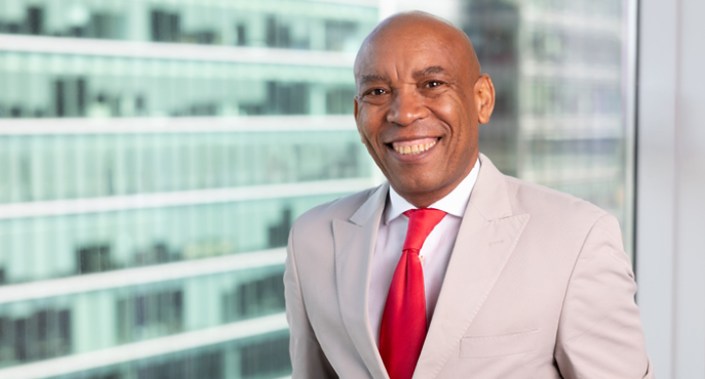
A guiding principle Alfred Ramosedi, FCMA, CGMA, follows is to never be defeated by a crisis — and it takes courage to transform uncertainty into opportunity.
Ramosedi has exemplified that throughout his career. During the onset of the COVID-19 pandemic, he transformed the business model of Bayport SA, where he is CEO, to focus on employee financial wellness programmes — transforming disruption into a chance to serve people better.
Today, as artificial intelligence (AI) and other technologies change how management accountants do their work, he sees the same pattern emerging — management accountants need to pivot and adapt quickly. New technologies streamline research, automate analysis, and free up a management accountant’s time for higher-value thinking, but Ramosedi says the real opportunity isn’t just efficiency. There’s a bigger opportunity to elevate human judgement, human connection, and human discourse.
Ramosedi believes uncertainty is not something that management accountants should fear. Rather it is an invitation to invest in the things machines can’t replicate — the ability to understand people, communicate with them, and lead them through decision-making.
This view will be at the forefront of Ramosedi’s tenure in 2026–2027 as CIMA president and co-chair of the Association of International Certified Professional Accountants. He wants to focus on ensuring management accountants are at the centre of organisational strategy, reclaiming productivity through technology, driving value, and continuing to recruit the next generation of accountants.
Ramosedi is based in Sandton, South Africa. He grew up in the province of Free State, a mining and agricultural hub in east-central South Africa. The sixth of eight children, Ramosedi credits his strong ethics to his parents raising their children to be honest and not to look for shortcuts.
“I think that has given me a strong ethical background and helped me a lot in keeping things true north and always worrying about values in a company,” he said.
He spoke to FM magazine about his priorities, vision for the profession, and about technology. His responses have been edited for length and clarity.
Why did you initially become involved with CIMA?
Alfred Ramosedi: I went to work at the mine for about three years as a management accountant. I then left the mine in 1995 to join one of the largest banks in South Africa, [Nedbank Group Limited], as a management accountant. It was busy implementing activity-based costing — a methodology that management accountants use to allocate costs. The bank’s prerequisite was that you must have a qualification. The company actually put it in my contract as part of my KPIs that I had to finish my CGMA qualification and become a CIMA member.
What appealed to you about becoming a management accountant?
Ramosedi: I believe everything comes together in finance — all the decisions and strategies. What appealed to me most is I got to be at the core of what a company does. Being a management accountant is about communicating in a very easy way to leaders and stakeholders what the business has achieved.
What areas will have your focus during your tenure as CIMA president?
Ramosedi: First, everything that I do has to be anchored in the strategy of looking ahead — something that comes easily for management accountants. We are trusted advisers, and the world needs advisers who are trusted today more than ever.
The second is we have to demonstrate value to our members so they can, in turn, demonstrate value and support their companies and clients.
The third focus point is professional judgement. That characteristic and its application are very important because the world is changing so much. With professional judgement, there is no easy answer, but we are better able to guide companies and clients.
Being forward looking and ethically driven are combined for my fourth focus point. For businesses to be successful, it is better to have management accountants who are able to predict and anticipate change. Those who can predict and then set effective strategy will be relevant … and set themselves apart. The world needs strong ethical leaders who will guide the decision-makers.
The fifth focus is technology, particularly AI. AI is a catalyst for growth, so we must embrace it. We can’t be scared of it.
Where would you like to see the future of CIMA and management accounting?
Ramosedi: I want to see CIMA become a big growth environment in the emerging markets. I think countries in the emerging markets are looking to augment their professional qualification offerings. They are trying to professionalise their workforces. And I want CIMA to be at the table when governments say, “We want to professionalise our civil service base”, for example.
What lessons from your career at Bayport do you want to bring to your presidency?
Ramosedi: I joined Nedbank as a management accountant in 1995, and because of the ability to be forward looking, work at the centre of the numbers, and be able to tell those stories, later on I became CEO at Bayport. I’ve learned two things:
One, when facing change, it’s up to you. CIMA and the CGMA qualification enabled that for me because I could engage with different stakeholders. The CGMA qualification gives you the courage to support stakeholders, translate numbers into actionable insights, and assist with decision-making. The CGMA qualification does change lives.
Two, I use a balanced scorecard to manage a company. A balanced scorecard is about four quadrants. One quadrant is to manage finance, but some people manage finance at the expense of everything, and you can’t do that. You have to have a balanced way to manage finance with the other three quadrants — customers, processes, and people. You’re not going to drive profits at the expense of people or driving up risks.
Are there any standout or critical moments that changed the trajectory or outlook of your career?
Ramosedi: Everybody remembers where they were when the COVID-19 pandemic happened. At Bayport, we were forced to change our strategy because the way we were doing our business … we relied on engaging face to face with clients. People were told to stay away for three months, and the limited access we had to people was a problem. I had to overhaul the whole organisation in three months. Our business relied on providing people with loans … but 80% of our customers could not pay us.
The South African employee market has a problem — clients who tend to take on more loans than they can afford to pay. Inflation increases put pressure on clients’ ability to pay, and clients can move from a two-person-working household to one, which then puts pressure on them being able to pay.
If we reduced their instalments and provided them with education to manage their finances, they paid us better. That was an “aha” move.
What then happened is we changed our model completely. We sign up employers and provide financial literacy to employees … We had to change in three months … We didn’t have relationships with companies. We didn’t have payroll collection on our books. But today, 100% of what we do is financial literacy supported by employers.
How is the value of the management accounting profession tied to public trust?
Ramosedi: The decision-makers are not the ones who do all the work. The leaders in organisations rely on strong feedback and key messages that come from the ground to enable them to make decisions. The best information is that which comes from the bottom of the organisation — employees who implement the solutions. As such, they have an ear on the ground, so to speak, to enable the filtering of information. Management accountants are best suited in translating those decisions to enable leaders to make the right decisions.
If management accountants are going to influence, we need to have trust.
Public trust is very important. If something is amiss in management accounting, the public can come back [to us] to ask and get answers, or we’ll fix it. That’s the public trust.
What do you think the profession is getting right about AI and where is it falling behind?
Ramosedi: What I think the profession is getting right is that we’re not rushing to implement AI for the sake of AI. We are looking very carefully at AI because AI is here to stay. AI is going to permeate everything that we do … and what we are doing right is making sure that we’re taking our time to apply it appropriately.
I think we could do a little bit better on change management because every time we see a wave of tech changes coming in, people always think that it is coming to replace them. AI doesn’t replace a person, it replaces a skill, outcome, or functionality.
What emerging technologies excite you most about the profession’s future?
Ramosedi: I am very excited about agentic AI … We now have the ability to create processes that can work alongside people and free them up from doing certain mundane tasks. But the tech will not be able to translate decisions into strategies — that will still be up to you to translate, but you won’t be spending five hours typing reports and researching.
Combine agentic AI with myself … I can become more productive, taking the organisation to an even higher performance level than before.
What competencies do you believe management accountants need to prioritise to stay relevant in this tech-driven economy?
Ramosedi: For me, it’s two things: an ability to interpret and ability to communicate in a very simple manner.
We talk in a way about being storytellers and being advisers. We need to be able to do those as a package … starting with the communication piece.
What do you think is the biggest misconception young people have about accounting and management accounting?
Ramosedi: I think the misconception is that we only produce numbers … and that we are not involved in strategy and communicating. I think, secondly, they believe management accounting is boring, and it’s not.
What skills do you think younger generations can bring into the profession?
Ramosedi: They’re not shy. They’re inquiring. They’re not scared. Whereas we more established accountants may have so much pride that we don’t want to fail. I think that’s what took us longer to adapt to change. Gen Z has got that inquiring mind, and they can bring that.
Jamie J. Roessner is a senior content writer at the Association of International Certified Professional Accountants. To comment on this article or to suggest an idea for another article, contact Oliver Rowe at Oliver.Rowe@aicpa-cima.com.