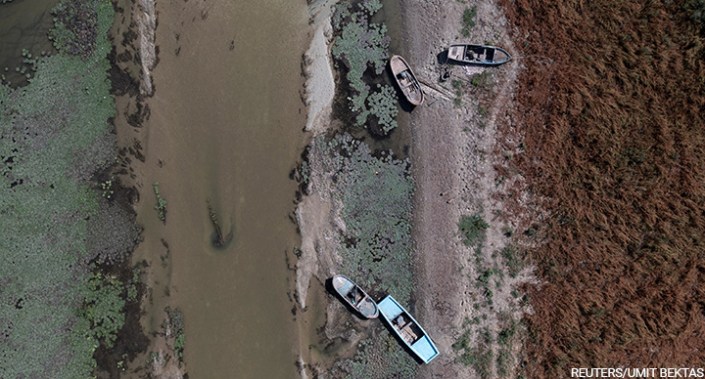
Global economic losses could reach $5 trillion under a “plausible increase” in extreme weather events linked to climate change that cause crop failures and food and water shortages, insurance marketplace Lloyd’s of London said on Wednesday.
Lloyd’s, which carried out the research alongside the Cambridge Centre for Risk Studies, stressed that its “systemic risk scenario”, which models the global economic impact of extreme weather, was hypothetical. But it said the work would improve business and policymaker understanding of their exposure to critical threats such as extreme weather.
When adjusting the potential $5 trillion in losses over a five-year period for the probability of those extreme weather events occurring, the expected global economic losses were $710 billion, Lloyd’s said.
“The global economy is becoming more complex and increasingly subject to systemic threats,” said Trevor Maynard, Ph.D., executive director of systemic risks at the Cambridge Centre for Risk Studies.
He added that the research would “help businesses and policymakers explore the potential impacts of these scenarios”.
Lloyd’s modelled global economic losses of extreme weather events by estimating the impact of food and water shocks on global gross domestic product over a five-year period.
The weighted average loss across the three severities it modelled — major, severe, and extreme — was $5 trillion over the five years, ranging from $3 trillion in the lowest severity scenario up to $17.6 trillion in the most extreme.
Lloyd’s also modelled for events concentrated in regions; it said extreme weather events centred in China would lead to the biggest losses, of $4.6 trillion.
The Caribbean region would lose 19% of its GDP over five years if the extreme weather events were concentrated there, Lloyd’s estimated.