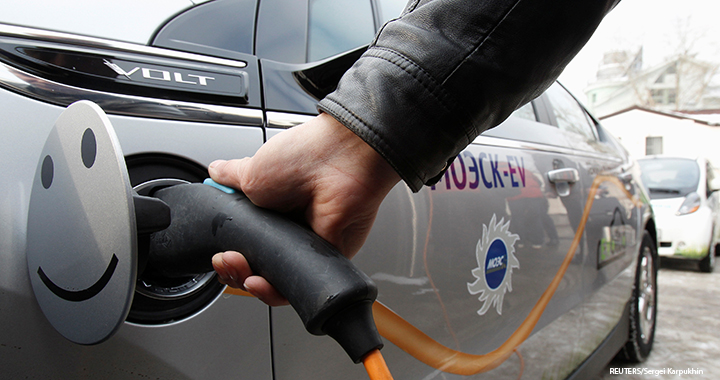
Russia plans to subsidise the purchase of domestically manufactured electric vehicles (EVs) to stimulate demand and production, the country’s economy ministry said on Wednesday.
The use of electric cars in the oil-and-gas-producing country has lagged far behind Europe and no EVs are made in Russia, but the government has ambitious production plans and is considering the financial stimulus to boost the sector.
Out of an estimated total of 45 million cars driven in Russia last year, only 11,000 were EVs, most of them used cars.
With electric cars being substantially more expensive than internal-combustion vehicles, the subsidy is aimed at making Russian-made EVs more affordable, Maxim Kolesnikov, department head at the economy ministry, told Reuters.
Through the subsidy, the government plans to cover 25% of the purchase price of any Russian-made electric car, to a maximum of RUB 625,000 ($8,570), possibly starting next year, he said.
Russia is targeting annual EV production of 220,000 units by 2030, and authorities have said that foreign automakers had shown interest in producing models locally.
Greater use of EVs would also help Russia meet carbon-reduction targets. The country joined the Paris climate pact in 2019 and aims to cut emissions to 70% of their 1990 levels by 2030, a target it should hit easily because of de-industrialisation since the Soviet Union broke up in 1991.
(Reporting by Gleb Stolyarov, Anastasia Lyrchikova, and Darya Korsunskaya; writing by Anastasia Lyrchikova; editing by Maria Kiselyova and David Holmes)